
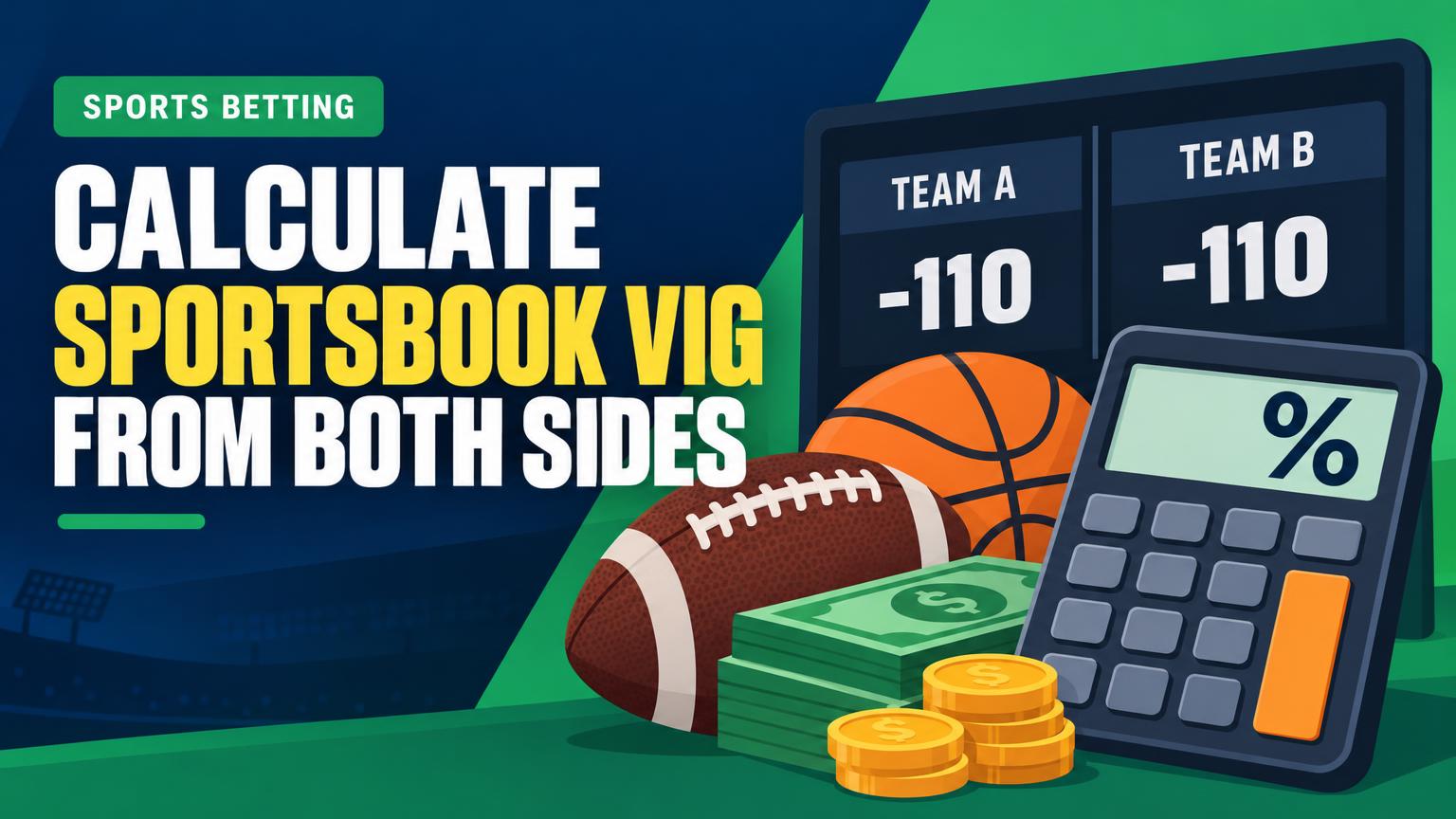
A market can price both possible winners without pricing them fairly.
A game shows −110 on each side. At those odds, each side has an implied probability of about 52.38%, for a combined 104.76%. Yet if these are the only two possible outcomes, their actual probabilities must add up to 100%. The extra 4.76 percentage points therefore cannot describe another chance for either team to win.
That excess is called the overround. It reflects the margin built into the quoted prices, not a guaranteed profit on every bet. Before treating it as a margin, both prices need to come from the same market and include every possible outcome; a market with a draw, for example, has a third price to count.
Match the two sides of the bet
Before calculating vig, record two current prices from the same sportsbook. They must cover the same event, two-way market, line, and settlement rules. For example, Team A −3.5 at −110 and Team B +3.5 at −110 form a valid pair if both prices are displayed at the same time and both bets treat overtime the same way.
Check the details beside each price, not just the team names. Team A −3.5 and Team B +4.5 are different spread lines, so their implied probabilities do not describe opposite sides of one bet. Likewise, a price copied before an odds update cannot reliably be paired with one shown afterward. The resulting total may look precise while measuring a combination the sportsbook never offered.
A three-way market also needs different treatment. In soccer’s 90-minute match-result market, home win and away win do not cover a draw; all three prices are needed to calculate its overround. For more context on what the resulting percentages represent, see sportsbook odds analysis basics.
Convert negative odds to implied probability
For negative American odds, take the absolute value of the odds, then divide it by that value plus 100:
Implied probability = |odds| ÷ (|odds| + 100)
The vertical bars mean “ignore the minus sign” for the calculation. At −110, the result is 110 ÷ (110 + 100) = 110 ÷ 210 = 0.5238, or 52.38% when rounded to two decimal places.
The 110 and 100 also describe the price: a winning stake of 110 returns 100 in profit, plus the original stake. The formula converts that relationship into a percentage, making the quote easier to compare with the price on the other side of the bet.
52.38% is the probability implied by the quoted price, not an independent estimate of how often that outcome will occur. It does not mean the sportsbook has determined the outcome’s true chance to be 52.38%. For a two-sided market, calculate each side’s implied probability from its own quoted odds before adding the percentages together.
Convert positive odds and combine both sides
For positive American odds, divide 100 by the quoted number plus 100:
Implied probability = 100 ÷ (positive odds + 100)
At +120, the calculation is 100 ÷ (120 + 100) = 100 ÷ 220 = 45.45%. As with negative odds, this is the probability implied by the sportsbook’s price, not a prediction of how often that outcome will occur.
A market can have one positive price and one negative price. Convert each side using its own formula, then add the results. For example, suppose the same two-outcome market lists one side at +120 and the other at −140:
- +120: 100 ÷ 220 = 45.45%
- −140: 140 ÷ (140 + 100) = 58.33%
- Combined: 45.45% + 58.33% = 103.78%
The total exceeds 100% by 3.78 percentage points. That excess is the market’s overround—a way to describe the margin built into these two quoted prices, rather than a guaranteed return to the sportsbook on any individual bet.
Add both sides and identify the overround
For a two-outcome market priced at −110 on each side, the same conversion applies twice:
- Side A: 110 ÷ (110 + 100) = 52.38%
- Side B: 110 ÷ (110 + 100) = 52.38%
- Combined: 52.38% + 52.38% = 104.76%
Only one side can win, so how can the total exceed 100%? These are probabilities implied by the sportsbook’s quoted prices, not two independent estimates of what will happen. The prices include a bookmaker margin, which pushes their combined implied probability above 100%. The amount above 100%—4.76 percentage points here—is called the overround.
A balanced market makes the distinction easier to see. If the two outcomes were assessed as equally likely, each would have a 50% chance, and their probabilities would total 100%. At −110/−110, the quoted price converts to 52.38% for each side instead. That does not mean both outcomes have become more likely; it means the quoted odds are less generous than odds with no margin built in.
The 4.76-point overround describes the prices, not a guaranteed profit on the bets placed. It also does not establish that the true chances are exactly 50/50; that is just a useful comparison for this symmetric example.
Subtract 100% to find the quoted margin
Once both sides have been converted and added, subtract 100% from the total implied probability:
104.76% − 100% = 4.76 percentage points
That excess is the market’s overround, often called its vig or bookmaker margin. The unit matters: 4.76 percentage points describes the gap between the quoted total and 100%. It does not mean the sportsbook earns 4.76% of all money staked on that event.
The calculation uses prices, not the amounts bettors actually place on each side. If more money backs one outcome, the sportsbook’s payout exposure changes. The result, the balance of bets, and any adjustments to payouts all affect what it ultimately keeps or loses. The quoted margin is therefore a way to compare a market’s odds, not a prediction of realized profit.
Nor does subtracting 100% reveal each side’s fair chance of winning. That requires a separate step to remove vig from the quoted odds. For the symmetrical −110/−110 example, a proportional adjustment assigns 50% to each side; an uneven pair needs its own adjustment. Those adjusted figures are estimates based on the odds, not independently verified probabilities.
Work through a −140/+120 market
Suppose one sportsbook lists the two sides of a market at −140 and +120. The negative price converts to 140 ÷ (140 + 100) = 58.33% implied probability. The positive price converts to 100 ÷ (120 + 100) = 45.45%.
Add the two results: 58.33% + 45.45% ≈ 103.79%. Subtract 100% to get an overround of about 3.79 percentage points. Keeping the fractions unrounded until the final step produces 103.7879%; using the displayed two-decimal probabilities may produce 103.78% instead. That small difference is rounding, not a different market margin.
Neither price reveals the overround on its own. At −140, one side implies 58.33%, but that figure says nothing about how the sportsbook has priced the other side. A +120 opposite side gives the total above; a different opposite price would change the total even if −140 stayed fixed. The calculation needs the complete set of outcomes from the same market.
This is also different from comparing the actual prices across sportsbooks. Comparing two books might show that one offers +120 where another offers +125 on the same selection. Calculating either book’s overround instead requires pairing its price with its own quote for the opposing outcome, under matching market rules. The 3.79-point figure describes the combined quoted probabilities, not a guaranteed return or the sportsbook’s realized profit.
Check the margin before using it
- Match the market
Both prices must come from the same sportsbook, at the same time, with the same line and settlement rules.
- Convert each price
For negative American odds, divide the absolute value by that value plus 100. For positive odds, divide 100 by the odds plus 100.
- Add, then subtract
Add the implied probabilities for every possible outcome before subtracting 100%. The remainder is the overround, expressed in percentage points.
- Keep the decimals
Retain several decimal places during conversion and round only the final result; early rounding can obscure small differences.
Small price changes can move the result. With the other side held at −110, the difference between −105 and −110 changes the two-sided overround from about 3.60 to 4.76 percentage points.
The figure describes the margin built into the quoted prices. It does not reveal either side’s true chance of winning or guarantee what the sportsbook will earn.