
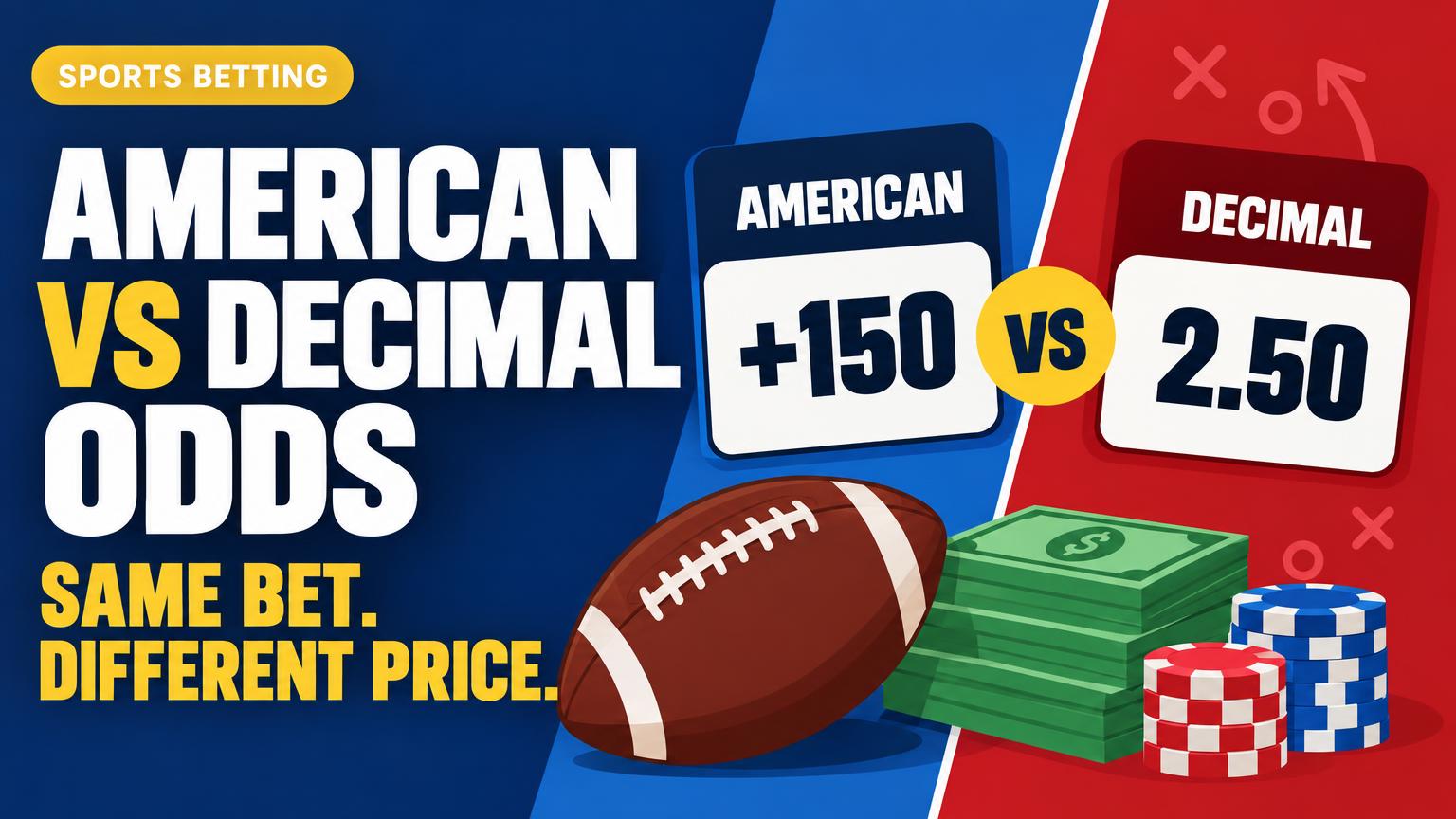
Different odds formats can make identical offers look unrelated.
A bettor opens two sportsbook tabs for the same team: one shows +150, the other 2.50. Assuming the bet terms match, those are the same price in different formats. A $100 stake would produce $150 in profit either way. Decimal odds show the total return, including the stake, so 2.50 means $250 back—not $250 in profit.
The minus sign in American odds creates a different trap. −150 does not mean a loss of $150; it means a $150 stake would be needed to make $100 in profit. Its decimal equivalent is about 1.67. Checking whether a figure represents profit, stake, or total return makes the two displays easier to compare.
Read what each odds format returns
American odds describe profit relative to a reference stake. A plus sign shows the profit on a 100-unit stake; a minus sign shows the stake needed to make 100 units of profit. Neither figure includes the original stake in its displayed number.
Decimal odds work differently: they show the total return per unit staked, including the stake. That difference matters when comparing the numbers at a glance.
For example, imagine a 100-unit wager at +150. A win produces 150 units of profit, plus the original 100 units back: 250 units returned in total. The same wager at 2.50 produces 100 × 2.50 = 250 units returned, again leaving 150 units of profit. The two prices describe the same payout, not different offers.
A negative American number reverses the reference point. At −150, a 150-unit stake would make 100 units of profit if the wager won; the full return would be 250 units.
Convert positive American odds to decimal
A plus sign in American odds shows the potential profit on a 100-unit stake if the bet wins. To express the same price as decimal odds, divide the positive number by 100, then add 1:
Decimal odds = (positive American odds ÷ 100) + 1
For +120, the calculation is 120 ÷ 100 + 1 = 2.20. A winning 10-unit stake would produce 12 units of profit and a 22-unit total return. For +150, it is 150 ÷ 100 + 1 = 2.50: a winning 10-unit stake would produce 15 units of profit and a 25-unit total return.
The 1 in the formula accounts for the original stake being returned. It is not another unit of profit. That distinction makes a quick comparison possible: +150 and 2.50 describe the same potential return, even though one format emphasizes profit and the other shows the total return as a multiplier.
Convert negative American odds to decimal
For negative American odds, divide 100 by the absolute value of the American number, then add 1. The absolute value is the number without its minus sign: for −150, use 150. Written as a formula, the conversion is decimal odds = 1 + (100 ÷ absolute value of American odds).
At −150, the calculation is 1 + (100 ÷ 150) = 1.666…, usually displayed as 1.67. At −135, it is 1 + (100 ÷ 135) = 1.7407…, usually displayed as 1.74. Both results are rounded to two decimal places, so calculating a return from the displayed decimal figure may give a slightly different result than calculating it from the original American odds.
The minus sign disappears because it describes how the American price works: −150 means a stake of 150 units would produce 100 units of profit. It does not mean a negative return. Decimal odds instead express the total return per unit staked, including the original stake, as a positive multiplier. For another way to interpret the same example, work out the probability behind −135.
Convert decimal odds back to American
A reverse conversion can help check whether an American price and a decimal price describe the same return. First, subtract 1 from the decimal odds. That leaves the profit portion of the return; the 1 represents the returned stake.
- At 2.00 or higher: Multiply the amount above 1 by 100 and add a plus sign. For 2.20, the calculation is (2.20 − 1) × 100 = 120, so the American odds are +120.
- Below 2.00: Divide 100 by the amount above 1 and add a minus sign. For 1.80, the calculation is 100 ÷ (1.80 − 1) = 125, so the American odds are −125.
Exactly 2.00 represents an even-money return and is commonly written +100 in American format. The same return can also be expressed as −100; the sign changes neither the profit nor the total return.
A displayed 1.74 converts back to about −135.14, not exactly −135. That does not necessarily signal a different price: −135 converts to approximately 1.7407 before a decimal display rounds it to two places.
Confirm the bets match before comparing odds
A converted price is useful only when both quotes describe the same bet. Before deciding which number looks more favorable, check the details behind each listing:
- Event and selection: Confirm the teams or players, competition, date, and chosen outcome. Similar names or a rescheduled event can cause confusion.
- Market and line: Match full game with full game, not first half with full game. A team at +3.5 points is a different selection from that team at +4.5, even if both listings say “spread.”
- Settlement rules: Check whether overtime counts and how a tie, push, or abandoned event is handled. These details can change what a winning bet means.
- Quote time: Note whether both odds are pregame or live and when each was displayed. A live quote may change before another page updates.
These checks matter when readers compare offshore and regulated sportsbook prices, since similar-looking markets may use different rules. If a detail does not match, treat the converted odds as a format translation—not evidence that one listing offers a more favorable price for the same outcome.
Compare the return and break-even percentage
Suppose two books quote the same selection under identical rules: one shows −135, while the other shows 1.80. Converting −135 gives 1 + (100 ÷ 135), or about 1.74 in decimal odds. The 1.80 quote therefore returns more for the same stake.
For each unit staked, −135 returns about 1.74 units total, including the original stake; 1.80 returns 1.80 units total. The profits are about 0.74 and 0.80 units, respectively. Comparing total returns with total returns—or profits with profits—keeps the difference clear.
The same comparison can be expressed as a break-even percentage. Divide 1 by the decimal odds, then multiply by 100:
- −135: 1 ÷ 1.7407 ≈ 57.45%
- 1.80: 1 ÷ 1.80 ≈ 55.56%
Using 1.7407 rather than the rounded display of 1.74 gives a more accurate figure for −135. At those quoted prices, the lower percentage for 1.80 means a selection would need to win less often to break even in a simplified calculation, assuming each bet has a win-or-loss result and no other adjustments apply.
An implied percentage describes the price being offered, not the selection’s actual chance of winning. Nor does the gap show that either book made a mistake. Quotes can differ for several reasons, including timing and how each book sets its margin; the reasons books quote different odds offer more context.
Check what the displayed odds actually mean
A decimal return includes the original stake.
At 2.50, a one-unit stake returns 2.50 units in total: 1.50 profit plus the stake.
−200 is a shorter price than −150.
At the same stake, −200 offers less profit; its larger magnitude signals a higher break-even percentage.
Displayed figures can hide small differences.
Quotes with different underlying values may both appear as 1.74 when shown to two decimal places.
Each side has its own quoted odds.
Bookmaker margin can push the two sides’ combined implied probabilities above 100%.
Check both quotes on the same basis
- Match the wager
Check the selection, line, settlement rules, and quote time. A different line can make a better-looking price misleading.
- Convert one format
Put both quotes in decimal odds or both in American odds before judging the difference.
- Allow for rounding
A displayed decimal such as 1.67 may represent a more precise underlying price, so a reverse conversion may not match exactly.
- Compare like with like
Use total return for the same stake, or compare implied break-even percentages for both quotes.
This check clarifies what each quote pays; it does not say which selection will win. For context beyond format conversion, see the guide to analyzing sportsbook odds.