
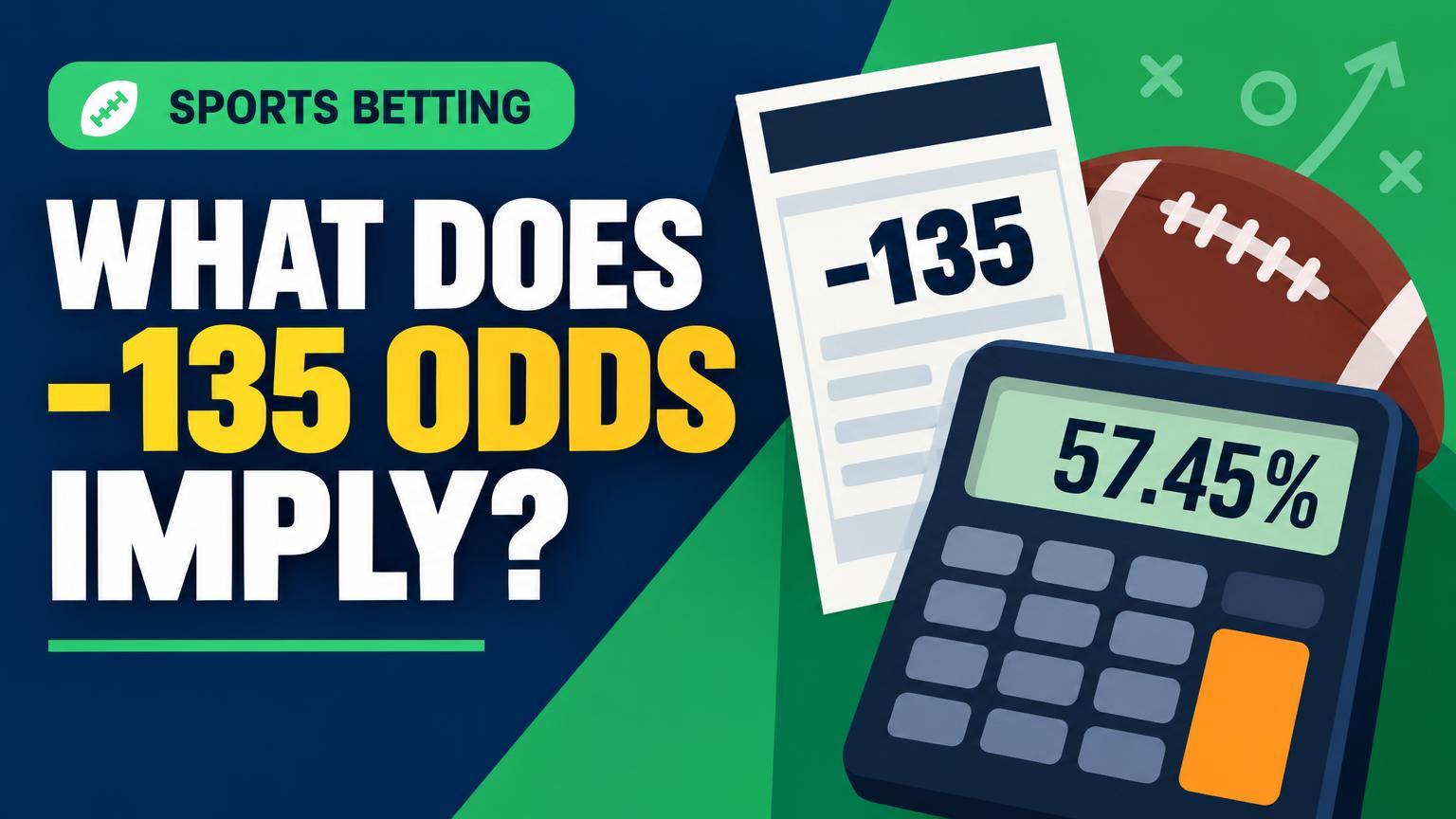
The minus sign marks a favorite, but it does not give the favorite’s chance of winning.
A team listed at -135 may look as though it has a 135% chance of winning. That cannot be right: probability tops out at 100%. The number describes the payout instead. In American odds, -135 means a stake of 135 units would return 100 units in profit if the bet won, plus the original stake.
To turn that price into an implied probability, divide 135 by 135 + 100. The result is 0.5745, or about 57.45%. That is the chance represented by the odds, not a measured prediction of how often the team will win. A sportsbook’s margin can also be built into its prices, so the implied probability need not match the team’s true chance.
Convert -135 odds to implied probability
- Read the stake and profit
At -135 American odds, a 135-unit stake would earn 100 units of profit if the bet won. The original 135-unit stake would also be returned, making the total payout 235 units. This stake-to-profit convention is a starting point for learning to analyze sportsbook odds.
- Choose the negative-odds formula
The minus sign determines which formula applies. For negative American odds, implied probability equals the absolute value of the odds divided by that value plus 100: |odds| ÷ (|odds| + 100). The absolute value removes the minus sign; it does not turn the probability negative.
- Substitute 135 for the odds value
The absolute value of -135 is 135, so the expression becomes 135 ÷ (135 + 100). Adding within the parentheses first gives 135 ÷ 235. The denominator matches the total payout from a winning 135-unit stake.
- Divide, then convert to a percentage
The division gives 135 ÷ 235 = 0.574468… . Multiplying by 100 converts the decimal to 57.4468…%, which rounds to 57.45% implied probability.
- Check what the result represents
The calculation treats the 135-unit stake as a share of the 235-unit total payout: 135 ÷ 235. It describes the probability implied by the quoted odds, not a separate prediction that the event will happen exactly 57.45% of the time.
Check the probability against the payout
The percentage becomes easier to interpret when tied to the payout. At -135, a 135-unit stake earns 100 units of profit if the bet wins; the original stake is returned separately. If the bet loses, the 135-unit stake is lost. The comparison is 100 gained versus 135 lost, not 235 gained versus 135 lost.
At the calculated break-even probability, a win occurs about 57.4468% of the time, leaving about 42.5532% for a loss. Multiplying each net outcome by its probability checks the average result:
0.574468 × 100 − 0.425532 × 135 ≈ 0
The first term represents about 57.4468 units of expected profit; the second represents about 57.4468 units of expected loss. They cancel out, apart from a tiny difference caused by rounding.
Another way to see it is to imagine 235 bets at those odds, each with a 135-unit stake. If 135 win, they produce 13,500 units of profit; if 100 lose, they cost 13,500 units. The 135 wins out of 235 bets equal approximately 57.45%. This checks the break-even math—it does not predict the results of any particular set of bets.
Separate the price from the forecast
The 57.45% implied probability from -135 describes a betting price, not a verified chance that the event will happen. A sportsbook may build a margin into its prices, so converting the odds directly does not necessarily reveal its view of the event’s likelihood.
Consider a hypothetical two-outcome market with -135 on one side and +115 on the other. The +115 side implies about 46.51%. Together, the two implied probabilities add up to 103.96%, not 100%. That excess illustrates the margin in the pair of prices; it does not mean both outcomes somehow became more likely.
The opposing price matters because -135 alone cannot show how much margin sits in the full market. One common way to remove the vig to find a fair probability is to divide each side’s implied probability by their combined total. In this example, 57.45% ÷ 103.96% gives roughly 55.26% for the -135 side.
That adjusted figure is a useful comparison point, but it is still derived from posted odds—not proof that the outcome will occur 55.26% of the time. The calculation also depends on using prices for opposite sides of the same market at the same time. If there are more than two possible outcomes, all of their prices belong in the total.
Compare the line with an independent estimate
The 57.45% implied probability provides a reference point for an independently estimated chance of winning. The two numbers answer different questions: the odds describe the quoted price, while an estimate attempts to describe what might happen. The comparison between implied probability and an independent estimate is most useful when the estimate comes from information considered separately from the odds.
Suppose an analysis puts the team’s chance at 60%. That is 2.55 percentage points above the break-even probability at -135. At a hypothetical 55%, the estimate falls 2.45 points below it. The arithmetic identifies a difference; it does not establish that either forecast is accurate.
An estimate may depend on uncertain inputs, such as a player’s availability or how much weight to give recent results. If a reasonable range for the estimated chance is 54% to 61%, it crosses the 57.45% threshold. In that case, a single figure such as 60% can make the comparison look more decisive than the evidence supports.
The earlier margin-adjusted figure of about 55.26% serves a different purpose: it approximates the favorite’s share after removing the example market’s margin. 57.45% remains the break-even point for the quoted -135 price.
Compare -135 with -120 on the same outcome
Suppose the same outcome is quoted at -120 instead of -135. Applying the negative-odds formula gives 120 ÷ (120 + 100) = 54.55%. That is about 2.90 percentage points lower than the 57.45% implied by -135.
The difference shows up in the payout. At -135, a 135-unit stake earns 100 units of profit if it wins. At -120, only 120 units need to be staked to earn that same 100-unit profit. The lower break-even percentage reflects that improved payout, not a change to the event itself.
A move from -135 to -120 does not, on its own, establish that the outcome has become less likely. It says the quoted price has changed. To see what a better price means for the same bet, compare the two break-even thresholds while keeping the underlying outcome—and any independent probability estimate—fixed.
The -135 calculation at a glance
For -135 odds, the calculation is 135 ÷ 235 = 0.574468, or about 57.45% implied probability. For other negative American odds, use the line’s absolute value: divide it by that value plus 100.
The result describes the quoted price, not the event’s verified chance of occurring. An estimate of that chance is a separate judgment, and the sportsbook’s margin can affect the price-derived percentage.